Raboan Discussion Forum was again held by the Center for Bioethics and Medical Humanities (CBMH FK-KMK UGM) on (16/03). On that occasion, the theme raised was Javanese Ancestor Sex Education: An Ethical Perspective. The event which was held virtually invited speaker Chandra Halim, M.A who is a lecturer in the History Study Program at Sanata Dharma University, Yogyakarta. Meanwhile, the moderator is dr. Galuh Dyah Fatmala.
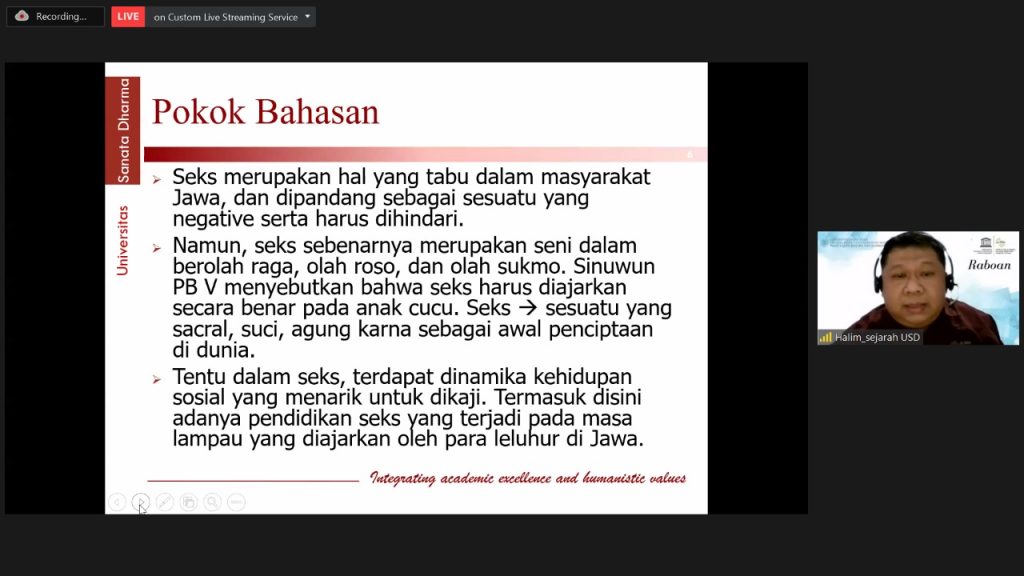
Chandra Halim’s presentation was motivated by a recent phenomenon, namely the many problems of sexual violence experienced by young people in Indonesia. According to Chandra Halim, this is one of the effects of sex education in Indonesia, which is still often considered taboo to talk about. So often the discussion of sex education is something that society avoids.
Based on a search conducted by Chandra Halim through historical evidence, found that in the past the Javanese ancestors gave sex education to young people. Sex education that was carried out at that time was not only knowledge about intercourse but also lessons about how to behave ethically between husband and wife.
In the past, Javanese ancestors in the Banjoemas district had known a tradition called Gowokan. This tradition is one of the traditions that teach ethics in married life, especially in sex education. The Gowokan tradition is carried out by a Gowok who has the duty of being a teacher to test how ready a young man is to be married.
A Gowok is often identified with a prostitute, even though according to Chandra Halim this is not the case. A Gowok is not a prostitute who just peddles the game of intercourse. But it is more obvious that Gowok teaches men to be men who are able to complete a woman and treat women well (lelaning jagad).
Besides Gowokan, another tradition that was also a practice of sex education in the past was Ngenger. The Ngenger tradition is a practice where the groom-to-be has to surrender to the prospective in-laws. He is allowed to sleep at the prospective in-laws’ house together with the bride-to-be. The tradition is carried out after the process of dowry. The practice of Ngenger is carried out so that the prospective groom familiarizes himself with the prospective bride’s family and the community around the prospective bride’s residence.
Not only in the form of tradition but the practice of sex education of Javanese ancestors is also found in ancient texts such as Serat Centhini, Serat Nitimani, and Serat Gatho loco. In the text, it was found that there were many things related to sex and women’s education. The Serat Panitisastra which is a legacy from the Pakubuwana V era also talks about many things related to women’s problems.
Material can be downloaded here
Raboan – Pendidikan Seks Leluhur Jawa: Perspektif Etika
Watch full video here