• UGM
  • IT Center
Universitas Gadjah Mada Center for Bioethics and Medical Humanities (CBMH)
Fakultas Kedokteran, Kesehatan Masyarakat, dan Keperawatan
Universitas Gadjah Mada
  • Tentang Kami
    • Visi & Misi
    • Sejarah
    • Staf dan Afiliasi
      • Pimpinan
      • SDM
      • Kolaborator Nasional
      • Kolaborator Internasional
  • Berita & Acara
    • Acara Mendatang
  • Briefings & Publikasi
    • Journal Article
    • Book Chapter
    • Teaching Module
    • Project Report
    • Others
  • Riset & Projek
  • Pendidikan & Kursus
    • Magister Bioetika
    • Kursus
  • Bioethics Teacher
  • Kegiatan
    • Program Rutin
    • Konsultasi Klinis
  • IBHC 2024
  • UNESCO Chair on Bioethics
  • Karir
  • SDGs CBMH FK-KMK UGM
  • Beranda
  • Events
  • Hierarchical Problems in Medical Service [Raboan Discussion Forum)

Hierarchical Problems in Medical Service [Raboan Discussion Forum)

  • Events, Past Event, Raboan, Uncategorized, Video, Video Terbaru
  • 16 September 2022, 13.57
  • Oleh: alifianuurma
  • 0

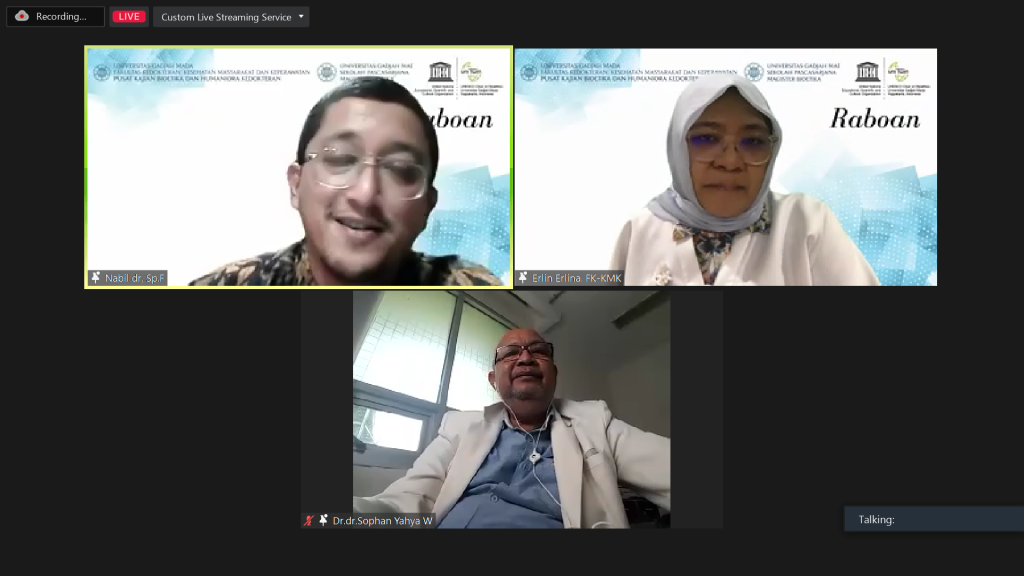
Wednesday (14/09) the Center for Bioethics and Medical Humanities again held the Raboan Discussion Forum routine. On that occasion, CBMH FK-KMK UGM raised the topic of Hierarchical Problems in Medical Services. The topic was presented by dr. Nabil Bahasuan., Sp.FM., S.H., M.H from the Faculty of Medicine, Hang Tuah University, Surabaya. The event was moderated by Erlin Erlina, S.IP., M.A., Ph.D.

dr. Nabil explained that recently there is a stigma spread among the community that makes police doctors not trusted by the public. This is according to dr. Nabil can be explained by examining the hierarchical problem in police medicine and military medicine.

According to dr. Nabil, currently there are no definite regulations governing the authority of police doctors. In contrast to military doctors who are bound by a military oath, the current rules for police doctors are equivalent to civilian doctors and are bound by a doctor’s oath and the Kodeki (Indonesian Medical Ethics Code).

dr. Nabil explained that there are three examples of systems that regulate police authority in handling criminal investigations, namely the Coroner system, the Medical Examiner system and the Continental system. The Coronary System was implemented in England and its colonies. The system stipulates that the examination of criminal victims is handled by the coroner’s team. Meanwhile, the Medical Examiner team was applied in the United States, especially New York. The system stipulates that the examination of victims is handled by a Medical Examiner team consisting of specialist doctors. Meanwhile, Indonesia adheres to the continental system. the system stipulates that examinations of criminal victims are carried out by doctors appointed by the police.


Watch full video here

Tags: bioethics Medical Service

Leave A Comment Cancel reply

Your email address will not be published. Required fields are marked *

*

Berita lainnya

  • BIOETIKA HUMANIORA MEDICAL ETHICS HELP Course Batch 7 – 4th Series “Bioethics in Health Care Services (Part 1)” untuk Penguatan Kompetensi Etik Tenaga Kesehatan
    December 12, 2025
  • raboan bioetika CBMH UGM Bahas Dimensi Etik Penggunaan Pengobatan Tradisional di Asia Tenggara dalam Forum Raboan
    December 12, 2025
  • pelatihan komite etik penelitian CBMH FK-KMK UGM Perkuat Kapasitas Komite Etik Penelitian di UPN “Veteran” Jawa Timur
    November 12, 2025
  • ethics and decision making Perkuat Kapasitas Etika Tenaga Kesehatan Melalui Workshop Pengambilan Keputusan Etis
    October 22, 2025
  • cek kesehatan gratis - cbmh ugm CBMH UGM Gelar Cek Kesehatan Gratis bagi Penyandang Disabilitas di Kelurahan Gading
    October 22, 2025
  • kuliah isu etika pelayanan kesehatan anak Bahas Isu Etika dalam Pelayanan Kesehatan Anak dan Remaja Bersama Prof. Dick Willems dari UMC Amsterdam
    October 22, 2025
Universitas Gadjah Mada

Gedung Penelitian dan Pengembangan FKKMK UGM Lt. 1 Sayap Utara

0274 547489
cbmhfkugm@ugm.ac.id

© Center for Bioethics and Medical Humanities Universitas Gadjah Mada

KEBIJAKAN PRIVASI/PRIVACY POLICY