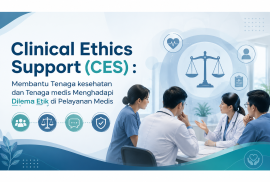
Pelayanan kesehatan modern saat ini berkembang sangat pesat. Kemajuan teknologi medis memungkinkan dokter dan tenaga kesehatan memberikan pelayanan yang berfokus pada pasien seperti transplatasi organ. Perkembangan ini memberikan manfaat besar bagi pasiennamun di sisi lain juga memunculkan berbagai persoalan etik dalam praktik klinis sehari-hari. (Molewijk et al., 2016). Dalam dunia medis, tidak semua keputusan dapat ditentukan hanya berdasarkan hasil pemeriksaan laboratorium atau diagnosis penyakit. Banyak situasi klinis yang melibatkan pertimbangan moral, nilai kemanusiaan, kondisi psikologis pasien, harapan keluarga, serta keterbatasan sumber daya rumah sakit. Kondisi inilah yang sering disebut sebagai dilema etik klinis. (Aulisio et al., 2000).
Publication
Oleh: Ika Setyasari, S.Kep.Ns., M.N.Sc
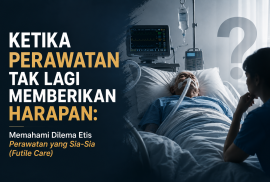
Masih teringat jelas suasana di sudut ruang ICU kala itu. Suara monitor yang berbunyi pelan, selang dan alat yang memenuhi tubuh pasien, serta harapan keluarga yang perlahan bercampur dengan ketakutan. Seorang kerabat dekat sedang berjuang mempertahankan hidupnya dengan berbagai instrumen kesehatan yang menopangnya. Hari demi hari berlalu, namun kondisi tak kunjung menunjukkan perbaikan.
Hingga akhirnya, dokter datang dan menyampaikan kalimat yang begitu berat untuk didengar.
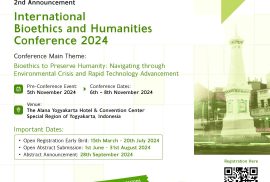
Unesco Chair on Bioethics, Universitas Gadjah Mada in collaboration with Center for Bioethics and Medical Humanities Faculty of Medicine, Public Health and Nursing, UGM, and Master of Bioethics, Graduate School of UGM proudly present
“The International Bioethics and Humanities Conference 2024”
Main Theme: Bioethics to Preserve Humanity: Navigating through Environmental Crisis and Rapid Technology Advancement
Event Date:
Pre-Conference Event: 5th November 2024
Conference Dates: 6th-8th November 2024
Venue:
The Alana Yogyakarta Hotel & Convention Center, Special Region of Yogyakarta, Indonesia
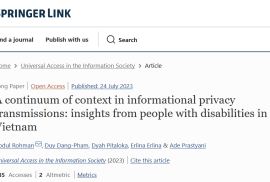
Writers
Abdul Rohman
Duy Dang‑Pham
Dyah Pitaloka
Erlina Erlina
Ade Prastyani
Abstract
The transmission of informational privacy has become a fertile ground for debate among competing actors affected by the proliferation of information communication technologies. Contexts are among the factors that shape the flow of informational privacy. The existing discussion however has been mainly dominated by perspectives from the Global North and the able-bodied. In response, based on interview data collected from people with disabilities (PwD) living in Vietnam, this study offers the continuum of context in informational privacy transmissions as a concept to illuminate the types, the levels, and the interest of the transmission and the capability of PwD to manage the flow of their informational privacy. The concept has the potential to enrich the existing discussion by providing more nuance and dynamic of informational privacy transmissions situated in the Global South and among groups who have been historically marginalized
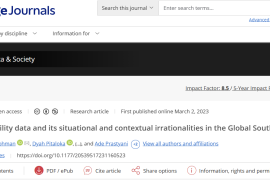
Authors
Abdul Rohman
Dyah Pitaloka
Erlina Erlina
Duy Dang
Ade Prastyani
Abstract
The inconsistent implementation of disability rights in crisis responses such as the recent COVID-19 pandemic has illuminated the double difficulty that persons with disabilities (PwD) must face. Ableism remains the basis for pandemic responses, leading to a range of irrationalities in collecting and using disability data during critical times. This commentary identifies situational and contextual rationalities in disability data collection and use in Global South. Through vignettes from Indonesia and Vietnam, this commentary illuminates the socio-technical and cultural infrastructure that perpetuates the obscurity of disability rights in the pandemic responses in, respectively, the largest democratic and socialist-communist countries in Southeast Asia. In addition to better listening to the voice of PwD, stronger engagement of organizations of PwD in policy making and programming is advocated for enabling more equitable pandemic preparedness, response, and recovery plans to manifest in future.Full paper can be accessed here
Writers
Agnes Bhakti Pratiwi
Hermawati Setiyaningsih
Maarten Olivier Kok
Trynke Hoekstra
Ali Ghufron Mukti
Elizabeth Pisani
Abstract
Objectives
To analyse the relationship between health need, insurance coverage, health service availability, service use, insurance claims and out-of-pocket spending on health across Indonesia.
Design
Secondary analysis of nationally representative quantitative data. We merged four national data sets: the National Socioeconomic Survey 2018, National Census of Villages 2018, Population Health Development Index 2018 and National Insurance Records to end 2017. Descriptive analysis and linear regression were performed.
Writers
Agnes Bhakti Pratiwi
Retna Siwi Padmawati
Dick L. Willems
Background:
The importance and attention to patient privacy in recent decades have been directed mostly toward medical data protection in electronic means. Hence, other aspects of patients’ privacy were overlooked, particularly in the primary health care (PHC) level. In the attempt of many countries, including Indonesia, to strive toward universal healthcare provision, a strong and accessible PHC is essential. This situation may create a tension in privacy provision where patients who need to disclose secrets may opt for other facilities, such as hospitals. This study aimed to describe and discuss patients’ and doctors’ perspectives and experiences about privacy in PHC in Indonesia, particularly since the universal coverage started.
Writers
Agnes Bhakti Pratiwi
Retna Siwi Padmawati
Joko Mulyanto
Dick L. Willems
Abstract
Background
Accessible and high-quality primary health care (PHC) is fundamental to countries moving towards universal health coverage. In order to improve the quality of patient-centered care provided in PHC, a comprehensive understanding of patients’ values is crucial to address any gaps in the health care system. This systematic review aimed to identify patients’ values relevant to PHC.
Methods
We searched primary qualitative and quantitative studies about patients’ values related to primary care in PubMed and EMBASE (Ovid) from 2009 to 2020. The studies’ quality was assessed using Joanna Briggs Institute (JBI) Critical Appraisal Checklist for both quantitative and qualitative studies and Consolidated Criteria for Reporting Qualitative Studies (COREQ) for qualitative studies. A thematic approach was used in the data synthesis.
Writers
Yayi Suryo Prabandari
Wika Hartanti
Syafriani
Mentari Widiastuti
Riani Witaningrum
Susanna Hilda Hutajulu
Matthew JohnAllsop
Abstract
Introduction
Limited research exists exploring the experience of living with advanced breast cancer in Indonesia. We sought to explore the narratives of women with breast cancer across the illness trajectory to understand their experiences from diagnosis to accessing and undergoing cancer treatments to inform the development of cancer care.
Methods
A nested, exploratory study adopting a qualitative approach. We conducted in-depth face-to-face interviews with women living with advanced breast cancer in Yogyakarta, Indonesia. We purposively sampled participants by age, education and marital status. All interviews were transcribed verbatim with thematic analysis used to identify, analyse and report patterns and themes within the data.
Reviving Critical Thinking and Sense of Ethics and Humanity through “Exploring Human Enhancement Technology”
Wika Hartanti(1*), Nurazid Mahardinata(2), Soenarto Sastrowijoto(3)
(1) Department of Medical Education and Bioethics; Faculty of Medicine, Public Health, and Nursing; Universitas Gadjah Mada; Indonesia
(2) Department of Medical Education and Bioethics; Faculty of Medicine, Public Health, and Nursing; Universitas Gadjah Mada; Indonesia Centre for Bioethics and Medical Humanities; Faculty of Medicine, Public Health, and Nursing; Universitas Gadjah Mada; Indonesia
(3) Department of Medical Education and Bioethics; Faculty of Medicine, Public Health, and Nursing; Universitas Gadjah Mada; Indonesia
(*) Corresponding Author